

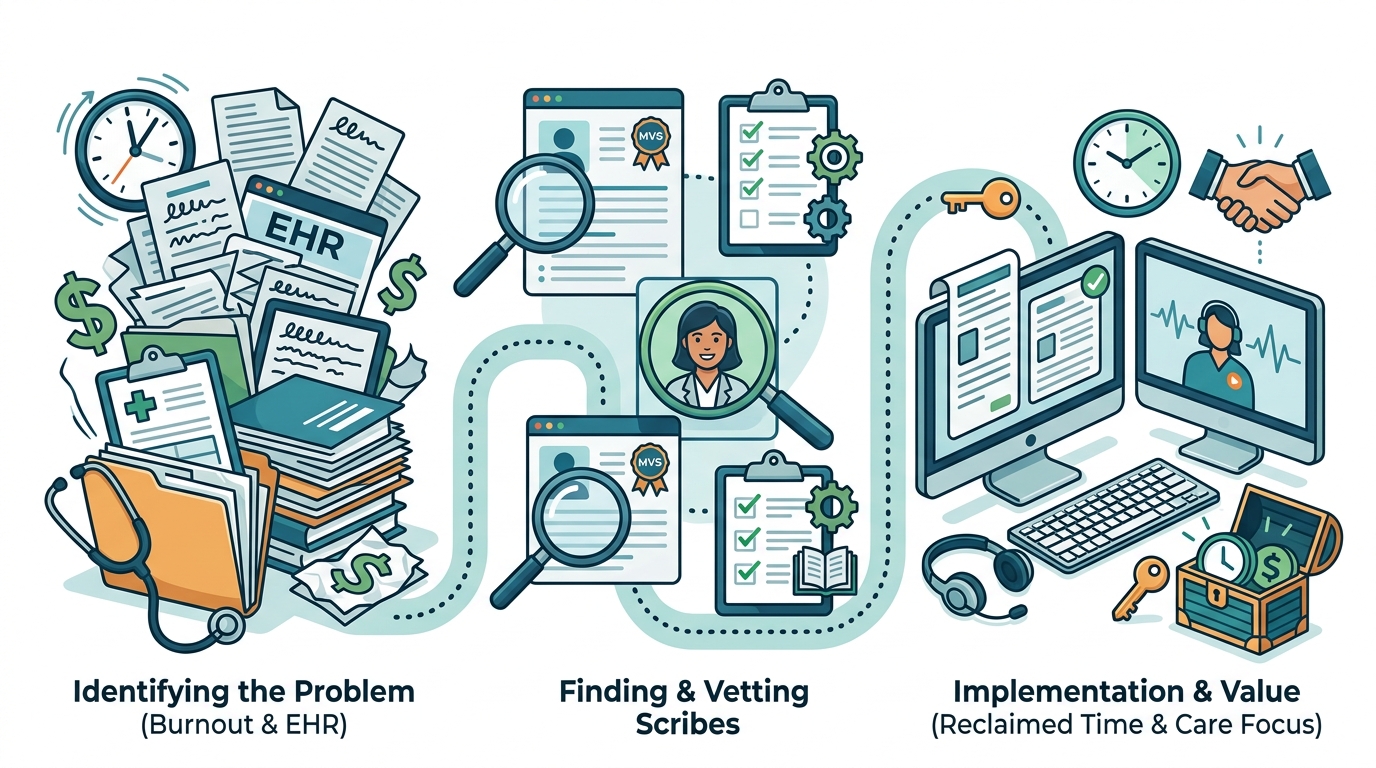
Physician burnout has reached critical levels in modern healthcare, with 74.5 percent of doctors citing electronic health record (EHR) documentation as a primary cause of their professional exhaustion. This overwhelming administrative burden steals approximately 66 minutes from every eight-hour shift, significantly reducing the time clinicians can spend on direct patient care. By systematically evaluating and hiring a qualified remote medical scribe, practices can reclaim this lost time, improve diagnostic accuracy, and restore the human connection at the center of medicine. This guide outlines the precise steps to secure a reliable virtual scribe service that aligns with your clinical workflow and compliance standards.
Step 1: Assess Your Practice Documentation Needs
Before contacting potential vendors, you must conduct a thorough audit of your current documentation bottlenecks. Identify which specialties within your practice suffer the most from charting delays. For instance, dermatology and oncology often require complex, real-time note-taking due to the volume of visual and clinical data involved. Virtual scribes are particularly effective in these high-volume environments because they can capture nuanced details that might otherwise be missed during a busy consultation.
Determine the specific volume of patients you see daily and the average length of your appointments. If your practice handles a high volume of short visits, you need a scribe service that can operate with minimal latency. Conversely, if you perform lengthy procedures, you require a scribe who can manage extensive procedural notes without disrupting the clinical flow. Understanding these operational metrics allows you to request accurate staffing estimates from potential providers.
Step 2: Verify HIPAA and Data Security Compliance
Healthcare data security is non-negotiable when hiring remote staff. Any virtual scribe service you consider must demonstrate rigorous adherence to HIPAA regulations. This goes beyond simple software encryption; it requires a comprehensive security infrastructure that protects patient data at every touchpoint. Look for providers that explicitly mention workspace security powered by Virtual Private Networks (VPNs) and other protective screening measures.
Ask potential vendors about their employee vetting processes. Do they conduct background checks on their scribes? How do they ensure that remote workers are using secure, private environments to access your Electronic Medical Records (EMR) system? A reputable provider will have transparent policies regarding data privacy and will readily provide documentation of their compliance certifications. HIPAA guidelines mandate strict controls over protected health information (PHI), and your scribe service must meet these standards without exception.
Step 3: Match Scribe Specialties to Your Field
Not all medical scribes are created equal. The terminology and workflow in dermatology differ vastly from those in optometry or general internal medicine. When evaluating candidates, prioritize services that offer specialized training for your specific medical field. A scribe trained in oncology will understand the complex staging systems and treatment protocols required for accurate documentation, whereas a generalist might miss critical details.
My Virtual Scribe, for example, offers tailored support for dermatology, optometry, and dental practices. This specialization ensures that the scribe is already familiar with the specific codes, anatomical terms, and procedural nuances relevant to your daily work. This reduces the onboarding time and minimizes the risk of documentation errors that could lead to billing denials or clinical misunderstandings.
Step 4: Ensure Seamless EHR Integration
Your virtual scribe must be able to work directly within your existing Electronic Health Record (EHR) system. Whether you use Epic, Cerner, AthenaHealth, or a smaller practice management software, the scribe service must have experience with your specific platform. Incompatibility between the scribe's interface and your EHR can lead to data silos, delayed charting, and increased frustration for your clinical staff.
During the evaluation phase, ask the vendor to demonstrate how their scribes access your EHR. Do they use a secure, dedicated portal? Can they input notes in real-time while you are still with the patient? Real-time documentation is crucial for maintaining the flow of the appointment and ensuring that the patient feels heard and understood. Research indicates that when physicians are assisted by a scribe, patient interactions improve because the doctor can maintain eye contact and focus on the patient rather than the screen.
Step 5: Analyze Pricing Models and ROI
Understanding the financial implications of hiring a virtual scribe is essential for long-term adoption. Most reputable services offer flexible pricing models, including hourly rates, monthly subscriptions, or per-visit fees. It is important to look beyond the sticker price and calculate the return on investment (ROI). While a virtual scribe represents an operational cost, the revenue generated from increased patient throughput and reduced burnout-related turnover often far exceeds this expense.
My Virtual Scribe offers competitive pricing structures designed to be accessible for small practices and solo practitioners. By providing affordable remote medical scribes, they enable clinicians to delegate administrative burdens without breaking their budget. When comparing vendors, ensure that the pricing model scales with your practice growth. Avoid services that charge exorbitant fees for additional scribes or penalize you for fluctuating patient volumes.
Step 6: Conduct a Risk-Free Pilot Program
Never commit to a long-term contract without first testing the service in your actual clinical environment. A pilot program allows you to evaluate the scribe's accuracy, speed, and professionalism in real-world conditions. During this trial period, monitor how well the scribe integrates with your team and how their documentation impacts your end-of-day workflow.
Provide feedback to the vendor during the pilot phase. If a scribe is missing key details or using incorrect terminology, the vendor should be able to quickly retrain or replace them. A high-quality service will offer a risk-free trial period, allowing you to assess the value proposition without financial commitment. This step is critical for ensuring that the virtual scribe enhances your practice rather than disrupting it.
Comparison of Virtual Scribe Service Features
| Feature | My Virtual Scribe (MVS) | Traditional On-Site Scribe | General AI Documentation Tools |
|---|---|---|---|
| Specialty Training | Yes (Derm, Opto, Dental, etc.) | Varies by Hire | No |
| HIPAA Compliance | Strict (VPN, Screening) | Dependent on Facility | Varies |
| Cost Efficiency | High (Remote Model) | Low (Salary + Benefits) | Medium |
| Real-Time EHR Entry | Yes | Yes | Post-Visit Processing |
| Scalability | Instant | Slow (Hiring Process) | Instant |
Key Takeaways
- Burnout Reduction: 74.5% of physicians cite EHR documentation as a major factor in burnout, making scribes a critical intervention.
- Time Savings: Scribes save an average of 66 minutes per eight-hour shift, allowing for more patient interactions.
- Patient Satisfaction: 57% of patients report better interactions when their doctor is assisted by a scribe.
- Specialty Focus: Services like My Virtual Scribe offer specialized support for dermatology, optometry, and dental practices.
- Founder Expertise: MVS was founded by Dr. Behzad Ourmazdi, a neurologist with over 20 years of clinical experience.
- Security First: All remote scribes use VPN-powered workspace security to ensure HIPAA compliance.
- Flexible Pricing: Affordable models are available for small practices, starting at competitive rates.
Frequently Asked Questions
What is a virtual medical scribe?
A virtual medical scribe is a remote healthcare professional who documents patient encounters in real-time within the Electronic Health Record (EHR) system. Unlike traditional on-site scribes, virtual scribes work from secure, remote locations, allowing practices to access specialized talent regardless of geographic location.
How does a virtual scribe ensure HIPAA compliance?
Virtual scribes ensure HIPAA compliance through rigorous data encryption, secure Virtual Private Network (VPN) connections, and strict employee vetting processes. Reputable providers also conduct regular security audits and train their staff on the latest privacy regulations to protect patient data.
Can virtual scribes work with any EHR system?
Most established virtual scribe services are trained to work with major EHR platforms such as Epic, Cerner, and AthenaHealth. However, it is essential to confirm compatibility with your specific system before hiring to ensure seamless integration and real-time documentation.
What are the benefits of hiring a specialty-specific scribe?
Hiring a specialty-specific scribe ensures that the documentation is accurate and uses the correct medical terminology for your field. For example, a dermatology scribe will be familiar with skin lesion descriptions and procedural codes, reducing the need for post-visit corrections and improving billing efficiency.
How much does it cost to hire a virtual medical scribe?
The cost varies by provider and the level of service required. My Virtual Scribe offers affordable pricing models designed for small practices, often starting at competitive rates. The investment is typically offset by the increased patient throughput and reduced administrative burden.
Is there a trial period available?
Yes, many reputable virtual scribe services, including My Virtual Scribe, offer risk-free trial periods. This allows you to evaluate the scribe's performance, accuracy, and integration with your workflow before committing to a long-term contract.
How do virtual scribes handle patient privacy?
Virtual scribes handle patient privacy by accessing your EHR system through secure, encrypted connections. They are bound by strict confidentiality agreements and HIPAA regulations. Providers also implement workspace security measures, such as VPNs, to prevent unauthorized access to patient data.
Ready to Reclaim Your Time?
Stop letting paperwork dictate your day. By following these steps, you can find a virtual scribe service that enhances your practice, improves patient satisfaction, and reduces burnout. My Virtual Scribe offers specialized, HIPAA-compliant remote scribes tailored to your unique clinical needs. Contact us today to schedule a consultation and discover how our services can transform your healthcare practice.