

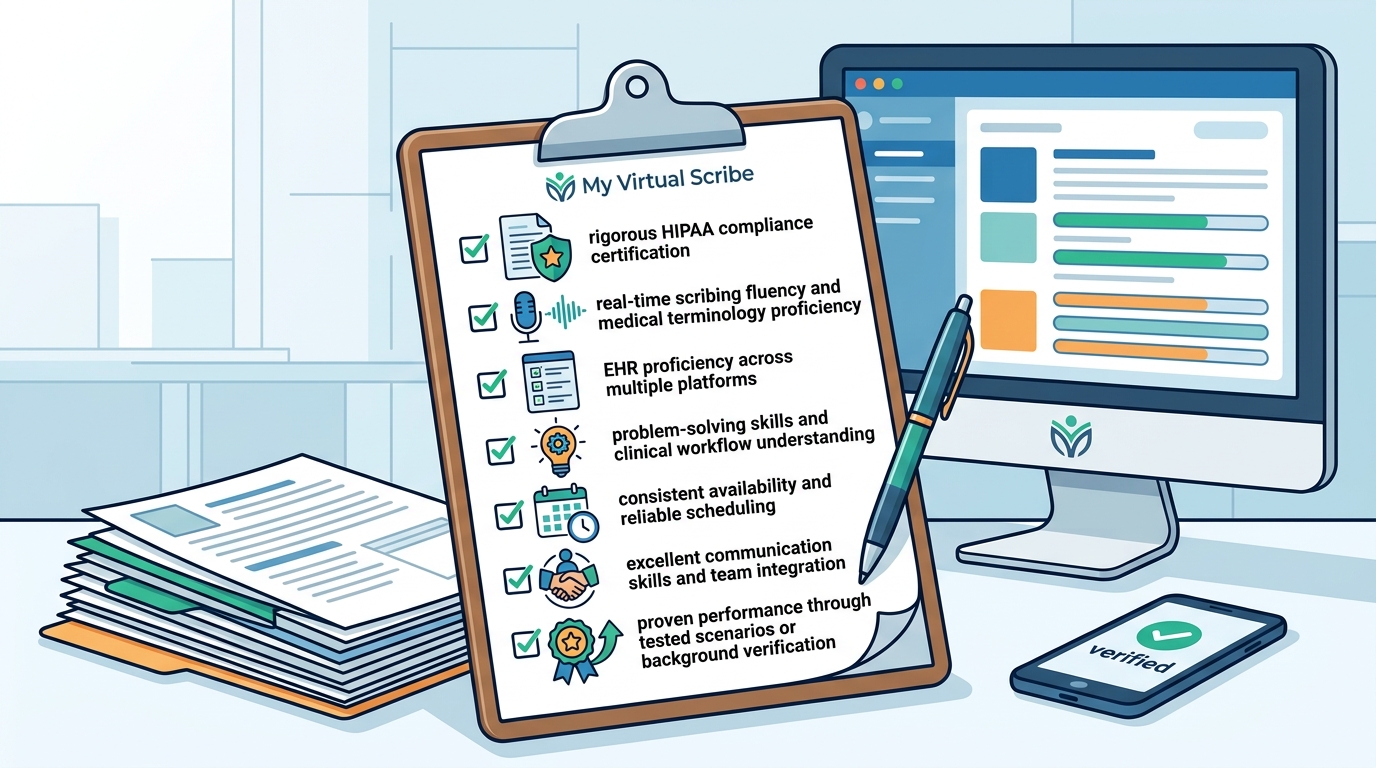
Physician burnout has reached critical levels in modern healthcare, with 74.5% of doctors citing EHR documentation as a primary cause of their exhaustion. This statistic is not merely a number but a reflection of a systemic crisis that threatens the sustainability of medical practices. When you hire a virtual medical scribe, you are not just outsourcing a task; you are investing in a workflow transformation that directly impacts your mental health, patient satisfaction scores, and practice revenue. The market is flooded with providers, but not all virtual scribe services are created equal. Distinguishing between a generic administrative assistant and a specialized medical documentation professional requires a rigorous evaluation framework.
1. Verify HIPAA Compliance and Data Security Infrastructure
The first and most non-negotiable criterion is security. A virtual scribe accesses Protected Health Information (PHI) in real-time. Therefore, the provider must demonstrate robust adherence to the Health Insurance Portability and Accountability Act (HIPAA). This goes beyond a signed Business Associate Agreement (BAA). You must investigate their technical safeguards. Do they use encrypted virtual private networks (VPNs)? Are their servers located in secure, compliant data centers? According to the U.S. Department of Health and Human Services, failure to protect PHI can result in severe financial penalties and reputational damage. A reputable provider like My Virtual Scribe explicitly highlights workspace security powered by VPNs as a core component of their service, ensuring that every data point transmitted during your patient encounter remains encrypted and inaccessible to unauthorized parties.
2. Assess EHR System Compatibility and Integration
Your electronic health record (EHR) system is the backbone of your practice. The virtual scribe must be fluent in your specific platform. Whether you use Epic, Cerner, AthenaHealth, or a smaller niche EMR, the scribe needs to navigate it with the speed and accuracy of an in-house staff member. Poor integration leads to documentation errors, delayed billing, and frustrated patients. Look for providers who offer pre-configured templates for your specific EHR. This reduces the learning curve and ensures that the data entered is structured correctly for billing and coding purposes. The American Medical Association notes that efficient EHR usage is directly correlated with reduced physician burnout and improved clinical outcomes.
3. Evaluate Specialty-Specific Medical Terminology Proficiency
Generalist scribes often struggle with the nuanced language of specialized fields. A dermatologist needs a scribe who understands complex skin lesion descriptions, while an oncologist requires precision in chemotherapy regimens and staging. When you hire a virtual medical scribe, demand proof of specialty training. Ask if their scribes have prior clinical experience or specialized certification in your field. For instance, virtual scribes for dermatologists require a different vocabulary than those in primary care. Providers that offer specialized teams, such as those for optometry or dental practices, demonstrate a deeper understanding of the unique documentation requirements of each niche.
4. Analyze Workflow Integration and Real-Time Capabilities
The value of a virtual scribe lies in real-time documentation. Unlike post-visit transcription, which introduces delays and potential memory errors, a virtual scribe listens to the encounter and documents simultaneously. This allows you to maintain eye contact with your patient, fostering trust and improving the diagnostic process. According to research cited by the American Medical Association, 66 minutes are saved per 8-hour shift when using a medical scribe. This time savings is not just about efficiency; it is about reclaiming your career. Ensure the provider offers a seamless onboarding process that integrates their technology with your existing workflow without requiring extensive IT support from your side.
5. Scrutinize Quality Assurance and Feedback Loops
Documentation accuracy is paramount. Inaccurate notes can lead to claim denials, audit risks, and compromised patient care. Ask the provider about their quality assurance (QA) protocols. Do they have a dedicated team that reviews scribed notes for completeness and accuracy? Is there a mechanism for you to provide immediate feedback if a note is missed or incorrectly documented? A strong QA framework ensures continuous improvement and accountability. Providers that offer transparent pricing often include QA checks as part of their standard service, ensuring that you are not paying extra for the basic expectation of accuracy.
6. Check Scalability and Staffing Reliability
Your practice will have fluctuations in patient volume. Your scribe service must be able to scale up during peak times and scale down during slower periods without compromising quality. Inquire about their staffing depth. Do they have a large pool of trained scribes to cover for vacations, sick days, or unexpected surges in patient load? Reliability is key. A missed scribe shift can disrupt your entire day and delay patient care. Look for providers with a robust infrastructure that guarantees coverage. My Virtual Scribe emphasizes its mission to alleviate pain points by providing reliable, trained medical scribes who can adapt to the dynamic needs of healthcare facilities.
7. Calculate Return on Investment and Pricing Models
Finally, evaluate the financial impact. While cost is a factor, it should not be the sole determinant. Consider the return on investment (ROI). A virtual scribe can increase your patient throughput, reduce administrative overhead, and improve billing accuracy. Compare pricing models, such as hourly rates versus monthly subscriptions. Some providers offer affordable packages tailored for small practices, while others may charge premium rates for specialized services. Ensure you understand what is included in the price, such as onboarding, training, and technical support. The goal is to find a partner that offers value beyond just documentation, helping you build a sustainable and profitable practice.
Comparison of Scribe Service Models
| Feature | Traditional In-House Scribe | Post-Visit Transcription | Virtual Real-Time Scribe |
|---|---|---|---|
| Documentation Timing | Real-time | Delayed (Hours/Days) | Real-time |
| Physician-Patient Interaction | High | High | High |
| Cost Structure | High (Salary + Benefits) | Variable (Per Minute/Word) | Flexible (Hourly/Monthly) |
| Scalability | Low | High | High |
| HIPAA Compliance Risk | Managed In-House | Third-Party Risk | Provider Managed |
Key Takeaways
- Security First: Always verify HIPAA compliance and VPN usage before signing any contract.
- EHR Fluency: Ensure the scribe is trained on your specific electronic health record system.
- Specialty Knowledge: Choose a provider with scribes trained in your specific medical niche.
- Real-Time Impact: Real-time documentation saves an average of 66 minutes per shift for physicians.
- Quality Assurance: Demand a clear QA process to ensure documentation accuracy and billing integrity.
- Scalability: Confirm the provider can handle fluctuations in patient volume without service gaps.
- Founder Expertise: Services founded by practicing physicians, like My Virtual Scribe, often have a deeper understanding of clinical pain points.
Frequently Asked Questions
How much does a virtual medical scribe cost?
Pricing varies by provider and service level. Some companies offer hourly rates, while others provide monthly subscriptions. It is essential to compare the cost against the time saved and potential revenue increase from improved patient throughput.
Are virtual scribes HIPAA compliant?
Yes, reputable virtual scribe services are fully HIPAA compliant. They use encrypted connections, sign Business Associate Agreements (BAAs), and follow strict data protection protocols to safeguard patient information.
Can a virtual scribe work with any EHR system?
Most virtual scribe services are trained on major EHR systems like Epic, Cerner, and AthenaHealth. However, you should confirm compatibility with your specific version and any custom templates you use.
How does a virtual scribe improve patient experience?
By handling documentation in real-time, the physician can maintain eye contact and engage fully with the patient. This reduces screen time and fosters a more personal and trusting doctor-patient relationship.
What is the difference between a virtual scribe and a transcriptionist?
A virtual scribe documents in real-time during the patient encounter, allowing for immediate clarification and accurate context. A transcriptionist listens to a recording after the visit, which can lead to delays and potential errors due to lack of context.
Do I need to train the virtual scribe?
Most providers handle the initial training. However, you may need to provide specific details about your documentation preferences, coding requirements, and EHR workflow to ensure seamless integration.
How quickly can I start using a virtual scribe?
Onboarding times vary, but many providers can have a scribe ready within a few days to a week, depending on the complexity of your practice and the specific EHR setup.
Ready to Transform Your Practice?
Stop letting paperwork dictate your day. Reclaim your time, reduce burnout, and enhance patient care by partnering with a trusted virtual scribe service. Explore our specialized solutions and pricing options to find the perfect fit for your practice. Contact us today to schedule a consultation and take the first step toward a more efficient, fulfilling medical career.