

Healthcare practices can streamline EHR documentation workflows by adopting remote medical scribe services, implementing structured templates, and leveraging ambient AI tools. These strategies reduce the administrative burden on clinicians, allowing them to focus on patient care rather than data entry. By delegating documentation tasks to trained professionals, practices can significantly lower after-hours charting time and improve overall operational efficiency. For additional details, review the myvirtualscribe us.
Understanding Documentation Bottlenecks
Electronic Health Record (EHR) documentation is the process of recording patient data, clinical notes, and administrative details within a digital health system. Many practices struggle with this task because it often consumes a significant portion of a clinician's day. The complexity of modern EHR interfaces requires extensive clicking and typing, which disrupts the flow of patient care. This administrative load contributes to physician burnout and reduces the time available for direct patient interaction. For additional details, review the .
Identifying specific bottlenecks is among the first step toward improvement. Practices should track the time spent on charting during and after clinical hours. If clinicians are routinely working late to complete notes, the current workflow is unsustainable. Data from industry reports indicates that administrative tasks can account for a substantial percentage of a physician's workday. Recognizing these pain points allows leadership to target specific areas for intervention rather than applying broad, ineffective changes. For additional details, review the Customer Experience.
Integrating Remote Medical Scribes
The primary benefit of this approach is the reduction of after-hours charting. When a scribe completes the note during the visit, the physician can review and sign it later with minimal effort. This shift transforms documentation from a time-consuming task into a simple review process. Practices using remote scribes often report a significant decrease in the time spent on administrative duties. This allows clinicians to see more patients or take on additional responsibilities without increasing their workload. For additional details, review the Frequently Asked Questions.
Optimizing EHR Templates and Macros
EHR templates and macros are pre-built text blocks that allow users to insert common phrases or data sets with a single click. Optimizing these tools is a low-cost strategy to speed up documentation. Clinicians should regularly review their templates to ensure they are up to date and relevant to their specialty. Removing outdated or rarely used macros reduces clutter and speeds up the note-taking process. A well-organized template library can significantly reduce the number of keystrokes required to complete a standard note. For additional details, review the About.
Practices should encourage clinicians to share their most effective templates with colleagues. This collaborative approach helps standardize documentation across the team. Standardization improves data quality and makes it easier for other providers to read and understand the notes. It also simplifies the training process for new staff members. By creating a shared repository of best-practice templates, practices can ensure consistency and efficiency in their documentation workflows.
Leveraging Ambient AI and Automation
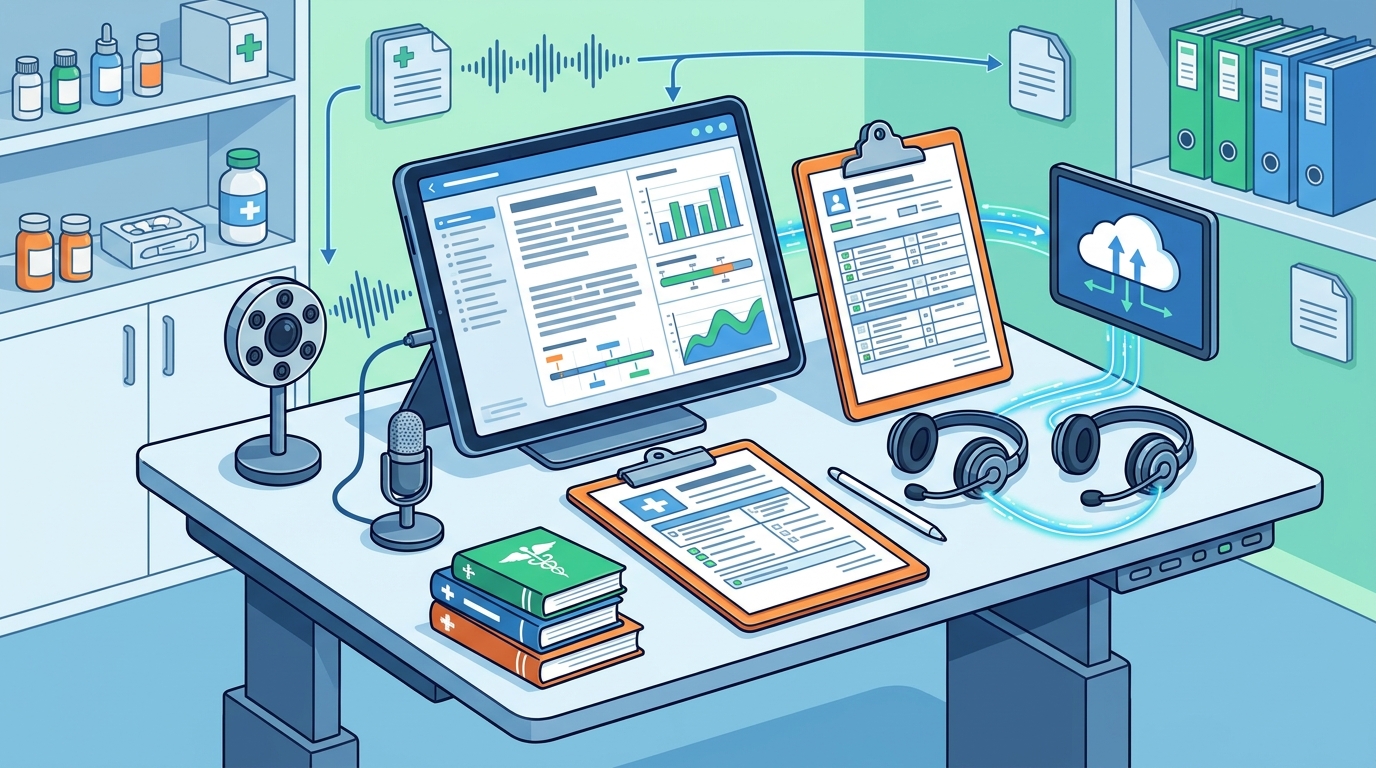
Ambient AI documentation tools are software systems that use natural language processing to capture and structure clinical conversations. These tools listen to the patient encounter and generate a draft note that the physician can review and edit. While not a replacement for human judgment, ambient AI can significantly reduce the time spent on initial data entry. It is important to note that these tools are designed to assist, not to replace, the clinician's role in the documentation process.
Implementing ambient AI requires careful consideration of data privacy and accuracy. Practices must ensure that the tools they use are HIPAA-compliant and have robust security measures in place. Additionally, clinicians should be trained to review and edit the generated notes carefully. The goal is to use technology to enhance efficiency, not to introduce new risks. My Virtual Scribe's services complement these technological advancements by providing human oversight and quality control for documentation tasks.
Establishing Workflow Governance
Practices should regularly audit their documentation workflows to identify areas for improvement. This can involve reviewing a sample of notes to check for completeness and accuracy. Feedback from clinicians and scribes is also valuable in identifying bottlenecks and suggesting improvements. By continuously monitoring and refining their workflows, practices can maintain high levels of efficiency and quality over time. This proactive approach helps ensure that documentation remains a manageable part of the clinical day.
Key Takeaways
- Remote medical scribes can significantly reduce after-hours charting time by completing notes in real time.
- Optimizing EHR templates and macros speeds up documentation and improves consistency.
- Ambient AI tools can assist with data entry but require careful review and HIPAA-compliant implementation.
- Workflow governance ensures that documentation practices are consistent, accurate, and compliant with regulations.
- Regular audits and feedback loops help identify and address documentation bottlenecks.
Frequently Asked Questions
How do remote medical scribes work?
Remote medical scribes join patient encounters virtually and input clinical notes into the EHR in real time. They listen to the conversation and document the details, allowing the physician to focus on the patient.
Are remote scribes HIPAA-compliant?
Can remote scribes work with any EHR?
Most remote scribe services are trained to work with a variety of EHR platforms. My Virtual Scribe scribes are proficient in several major EHR systems, ensuring compatibility with most practices.
How much time can remote scribes save?
The amount of time saved varies by practice and specialty. However, many practices report a significant reduction in after-hours charting time when using remote scribes.
Do remote scribes replace physicians?
What is the cost of remote scribe services?
The cost of remote scribe services varies depending on the provider and the level of service required. Practices should consult with providers like My Virtual Scribe to get a quote based on their specific needs. Learn more: myvirtualscribe us.