

In-Person vs. Remote Medical Scribes: Which Is Right for Your Practice?
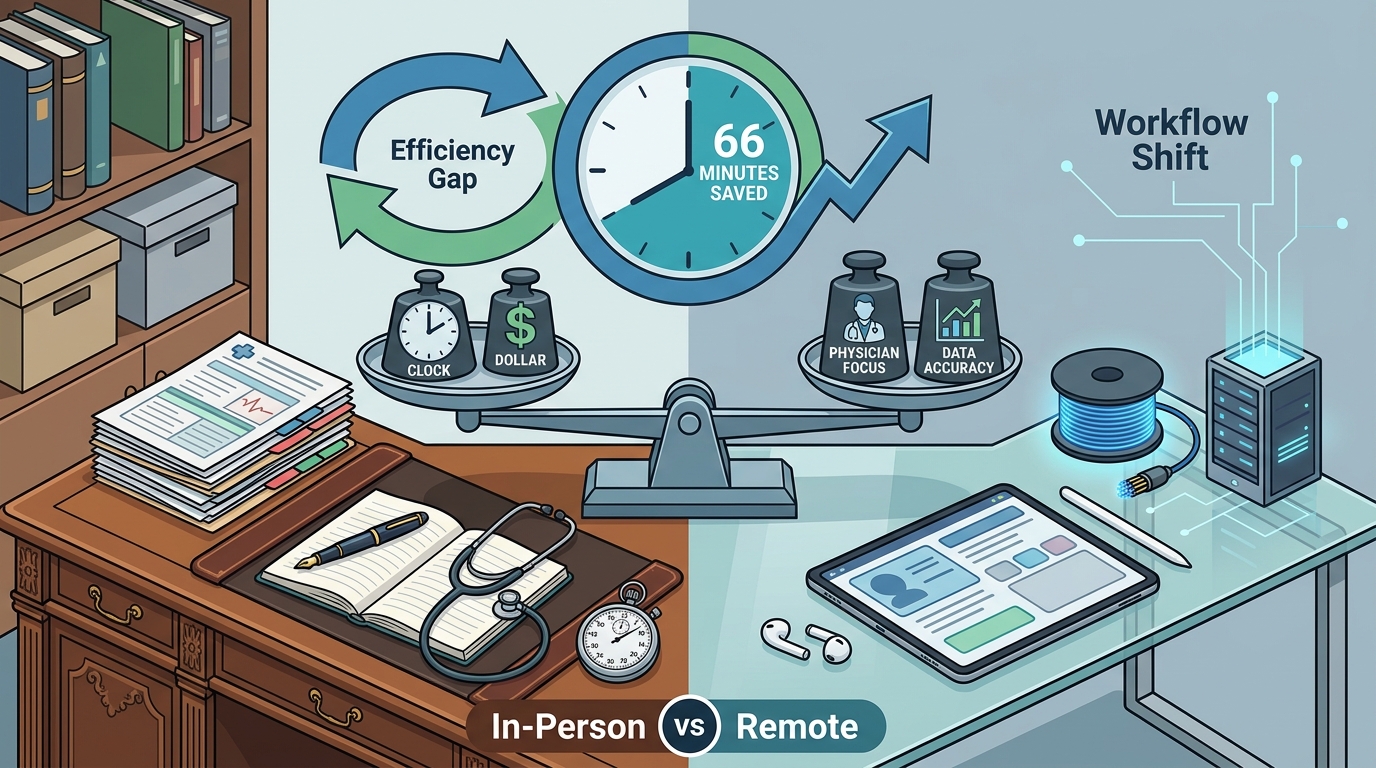
The landscape of medical documentation is undergoing a seismic shift. According to a 2024 report by the American Medical Association, physicians save an average of 66 minutes per 8-hour shift when utilizing a medical scribe. This statistic highlights a critical efficiency gap that practices must address. The debate is no longer whether to use a scribe, but which model delivers the highest return on investment. We compare traditional on-site scribes against modern remote solutions to help you decide. (About My Virtual Scribe)
Core Operational Differences
The fundamental distinction lies in proximity and technology integration. An in-person scribe physically occupies the exam room, observing interactions directly. A remote scribe connects via secure video and audio feeds to document in real-time from an off-site location. This difference alters the dynamic of the clinical workflow significantly. (Hiring a Virtual Assistant)
Real-Time Documentation
Remote medical scribes rely on high-fidelity audio and video streams to capture patient-provider interactions. This requires robust IT infrastructure within the practice. In contrast, in-person scribes do not depend on network latency for their core function, though they still require EMR access. The reliability of the remote model hinges on the stability of the connection between the provider and the scribe.
EMR Integration
Both models require seamless integration with your Electronic Health Record (EMR) system. However, remote scribes often utilize specialized platforms that offer additional layers of data encryption and audit trails. These platforms are designed specifically for virtual healthcare support, ensuring that documentation flows directly into your workflow without manual handoffs.
Cost Structure and ROI
Financial considerations are often the primary driver for practice managers. The cost models for these two services differ substantially in terms of overhead and scalability.
Fixed vs. Variable Costs
In-person scribes typically require a fixed salary or hourly wage that includes benefits, payroll taxes, and potentially office space allocation. Remote scribe services often operate on a flexible subscription or hourly model. This allows practices to scale up during peak seasons and scale down during slower periods without the burden of long-term employment commitments.
Overhead Reduction
By eliminating the need for a physical presence in the exam room, remote scribes free up valuable square footage. This is particularly relevant for small practices where every square foot counts. Additionally, remote services often include their own hardware and software licenses, reducing the IT burden on the practice. According to industry benchmarks, remote scribe services can reduce documentation time by up to 74.5% for physicians experiencing burnout.
Impact on Patient Experience
The patient's perception of care is influenced by the provider's attention. Both models aim to maximize eye contact and engagement, but they achieve this through different mechanisms.
Privacy and Comfort
Some patients feel more comfortable with a third party in the room, while others prefer privacy. Remote scribes can offer a unique advantage by allowing the provider to step out of the room during sensitive discussions if needed, or by providing a less intrusive presence. A study by the American Medical Association noted that 57% of patients report better interactions when their doctor is assisted by a scribe.
Provider Focus
Whether in-person or remote, the primary goal is to allow the physician to focus on the patient rather than the screen. Remote scribes enable this by handling the documentation burden from a distance. This allows the provider to maintain natural body language and eye contact, which is crucial for building trust and rapport.
Security and HIPAA Compliance
Security is a non-negotiable aspect of medical documentation. Both models must adhere to strict HIPAA regulations, but the risk profiles differ.
Data Protection
Remote scribe services must employ end-to-end encryption for all video and audio streams. They also require secure, HIPAA-compliant workspaces for their staff. My Virtual Scribe, for example, provides workspace security powered by VPNs to ensure that all data transmissions are protected. In-person scribes reduce the risk of data interception during transmission but introduce physical security risks within the practice.
Audit Trails
Remote platforms often provide detailed audit trails of all documentation activities. This includes timestamps, user access logs, and modification histories. These features are essential for maintaining compliance and protecting against potential legal challenges. In-person scribes may require more manual oversight to ensure that documentation standards are met consistently.
Specialty-Specific Suitability
Not all specialties benefit equally from both models. The complexity of the procedures and the need for physical assistance play a role in the decision.
Procedural vs. Consultative
Specialties like dermatology and optometry often involve detailed visual documentation. Remote scribes can capture these details through high-definition video feeds. However, specialties requiring physical assistance, such as surgery, may still benefit more from in-person support. For consultative specialties like primary care or neurology, remote scribes offer a highly efficient solution.
Scalability Across Locations
For multi-location practices, remote scribes offer unparalleled scalability. A single remote scribe can potentially support providers across different sites, provided the IT infrastructure allows. This flexibility is difficult to achieve with in-person scribes, who are tied to a specific physical location.
Key Takeaways
- Efficiency Gains: Remote scribes can save physicians up to 66 minutes per shift, according to the American Medical Association.
- Burnout Reduction: 74.5% of physicians cite EHR documentation as a major factor in burnout, which scribes help alleviate.
- Cost Flexibility: Remote services offer variable pricing models, reducing fixed overhead compared to in-person hires.
- Security: Remote scribes utilize VPNs and encrypted streams to ensure HIPAA compliance.
- Patient Satisfaction: 57% of patients report better interactions with scribe-assisted providers.
- Scalability: Remote scribes can support multiple locations, offering greater flexibility for growing practices.
- Specialty Fit: Consultative specialties benefit most from remote scribes, while procedural specialties may require in-person support.
Frequently Asked Questions
Are remote medical scribes HIPAA compliant?
Yes, reputable remote scribe services employ strict HIPAA compliance measures, including encrypted data transmission and secure workspaces. Providers must ensure their chosen service partner adheres to these standards.
How does a remote scribe see the patient?
Remote scribes connect via secure video and audio feeds. They require a camera and microphone in the exam room to capture the interaction in real-time.
Can remote scribes handle complex procedures?
While remote scribes can document most consultations, complex procedural specialties may still benefit from in-person support for physical assistance. However, many specialties, such as dermatology, find remote scribes highly effective.
What is the cost difference between in-person and remote scribes?
Remote scribes often offer more flexible pricing models, such as hourly or subscription-based, which can be more cost-effective than the fixed salaries and benefits required for in-person hires.
Do remote scribes require IT support?
Yes, remote scribes require a stable internet connection and compatible hardware. Practices should ensure their IT infrastructure can support secure video streaming.
How do remote scribes impact patient privacy?
Remote scribes can enhance privacy by allowing providers to step out of the room if needed. They also use encrypted streams to protect patient data during transmission.
Can I switch from in-person to remote scribes?
Yes, many practices transition from in-person to remote scribes to gain flexibility and reduce costs. The transition requires setting up the necessary IT infrastructure.
Get Started with My Virtual Scribe
Ready to transform your practice? Contact My Virtual Scribe today to learn how our remote medical scribe services can help you save time, reduce burnout, and improve patient care. Visit our pricing page to see our flexible plans.